
What was the challenge or problem to be solved?
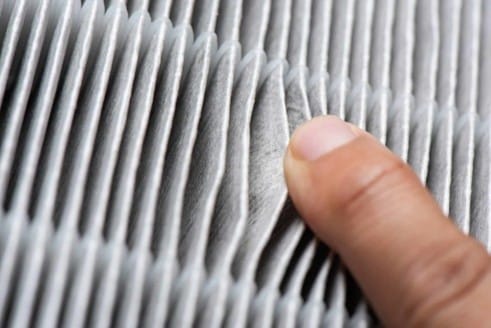
An industrial client needed to carry out a comparison of air filters before integrating them into one of its products, but there was no standardized method capable of accurately reproducing the required operating conditions.
The decision had to be based on proprietary experimental data, particularly regarding filter performance evaluation against specific contaminants such as volatile organic compounds (VOC). The challenge, therefore, was to define and execute filter efficiency tests in a controlled and technically reliable environment.
Comparison of air filters during the product development phase
The client was in a technical validation stage prior to industrialization. It needed to determine which filtration solution offered the best performance in terms of contaminant capture, stability, and sustained efficiency over time.
Although all candidate filters met general specifications, the actual differences could only be identified through comparative testing under homogeneous conditions. Factors such as filter media type, internal structure, or adsorption capacity could significantly influence the final outcome.
Controlled testing reveals real differences between seemingly equivalent filters.

The comparison of air filters had to be conducted by eliminating external variables that might bias the data. This required designing an environment in which the only changing factor was the filter itself. In this way, any observed difference in efficiency could be rigorously attributed to the material under evaluation rather than to inconsistent test conditions.
From the client’s perspective, having comparative data reduced reliance on commercial information and supported decision-making based on independent technical evidence aligned with its specific application.
Filter performance evaluation for technical decision-making
The objective of the project was to generate quantifiable information to support the selection of the most suitable component. This filter performance evaluation had to focus on the reduction of specific contaminants and on overall system efficiency under controlled conditions.
Particular attention was given to the reduction of volatile organic compounds (VOC), as these may affect both air quality and the operation of certain industrial devices. Measuring a single reduction value was insufficient; it was necessary to analyze the filter’s response to a sustained contaminated airflow over a defined period.
The evaluation also had to ensure repeatability. This means that the same filter, tested under equivalent conditions, should deliver consistent results. Without this guarantee, the data would lack comparative validity.
The objective of the project was clear: to enable the client to make technically sound decisions, minimize uncertainty, and reduce risks associated with integrating a critical component. The information generated influenced not only immediate design choices but also internal validation and qualification strategies.
Reliable experimental data reduces uncertainty in critical component selection.
Filter efficiency testing without a standardized method
The main technical challenge lay in the absence of a regulatory procedure tailored to the client’s specific requirements. The task was not to apply an existing standard but to define parameters consistent with the intended use case.
Designing the filter efficiency tests required establishing appropriate airflow rates, contaminant concentration levels, exposure times, and measurement points. Each of these variables could significantly affect the results if not precisely defined.
In addition, it was necessary to ensure that the experimental system did not introduce losses, leaks, or interferences that could affect measurements. Circuit tightness, flow stability, and sensor calibration were critical elements to guarantee data reliability.
In this context, INFINITIA’s Materials Innovation team took on the challenge of transforming an open technical need into a structured experimental approach capable of delivering technically defensible results.
How was it addressed or what was the solution?
To address this need, INFINITIA proposed the development of a test bench for air filters specifically designed for the project. The approach combined preliminary analysis, technical design, and experimental validation.
The work was structured into consecutive phases aligned with the Industrial R&D Consulting service, ensuring consistency between initial requirements and the final implemented solution. Each phase followed a clear technical logic: define, design, build, and validate.
Custom setup design for air filter testing with a modular approach
The first phase consisted of a detailed study of the required technical specifications. The operational conditions of the client’s final product were analyzed, determining airflow ranges, target contaminant concentrations, and measurement criteria.
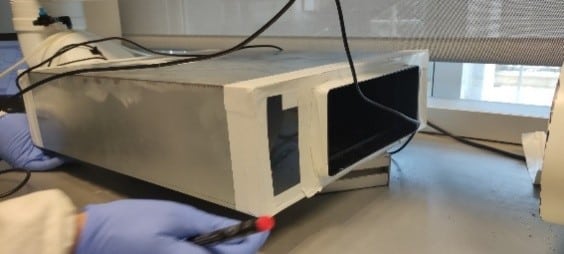
Based on this information, a custom setup for air filter testing was developed, prioritizing a modular architecture. This strategic decision allowed filters to be easily exchanged without modifying the rest of the system, ensuring direct comparability between samples.
Modularity also provided an additional advantage: the possibility of adapting the system for future tests involving other contaminants or configurations. The test bench was therefore conceived not as a one-off solution, but as a scalable experimental infrastructure.
Materials and components were selected according to chemical resistance, mechanical stability, and assembly precision criteria. Each element was designed to minimize unwanted pressure losses and maintain constant test conditions.
Custom test bench for VOC measurement using PID technology
Once the design phase was completed, the system was assembled using specialized tools to ensure proper integration of ducts, supports, and measurement devices. This custom test bench incorporated a VOC generator to simulate a contaminated airflow under controlled conditions. Artificial contaminant generation enabled stable and repeatable test scenarios.
Simulating real conditions is key to obtaining representative results.
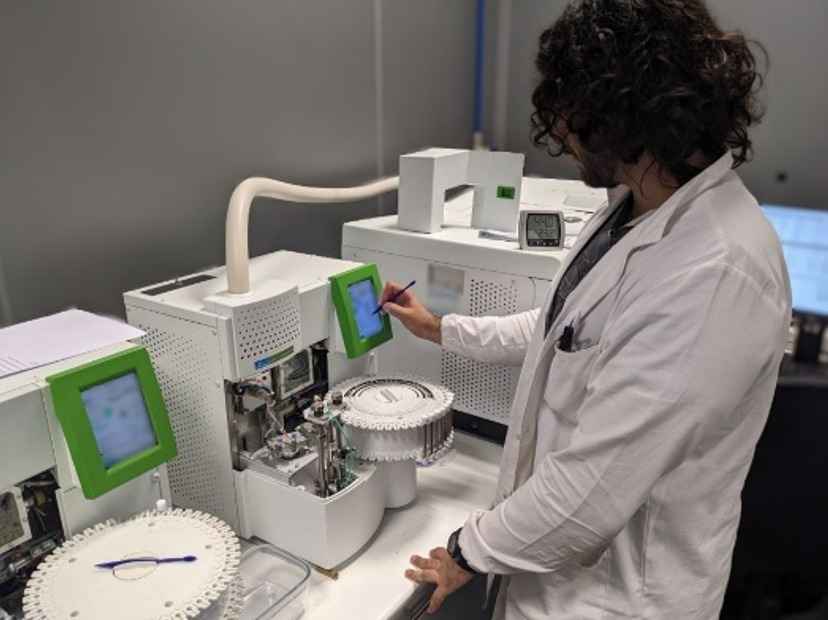
Measurements were carried out using gas sensors capable of detecting volatile organic compounds in real time. The strategic placement of measurement points before and after the filter made it possible to calculate capture efficiency based on comparable data.
During the commissioning phase, INFINITIA’s technical team verified flow stability, absence of leaks, and consistency of readings. Comparative testing only began once the system’s correct operation had been validated.
The result was a robust experimental environment that enabled rigorous testing and provided reliable information for the client’s decision-making process.
Reduction of volatile organic compounds (VOC) as an efficiency indicator
The results obtained made it possible to quantify each filter’s ability to reduce VOC concentration under controlled conditions. This information enabled a direct comparison between alternatives.
Beyond identifying the most efficient solution, the project provided insight into the relative behavior of each option under the same experimental scenario. This allowed the client to assess not only initial performance but also result consistency.
The developed system provides a replicable tool that can be used in future projects or adapted to new requirements. The value generated therefore extends beyond a single decision, strengthening the client’s internal technical validation process.
This case demonstrates INFINITIA’s capability to design custom experimental infrastructures when standardized methods do not meet specific needs. The combination of technical design, assembly, and test execution transformed an open requirement into concrete, actionable data.