
What was the challenge or problem to be solved?
In the food industry, introducing new product references into a catalogue requires ensuring the accuracy of declared nutritional information. The presence of minerals such as iron can become a relevant commercial argument, but also a risk if the values indicated by the supplier are not properly verified.
In this context, a company in the sector needed to confirm whether the iron content declared in a plant extract, specifically a curry leaf extract, was accurate. Before launching the product, it had to ensure that the declared levels were technically correct and supported by reliable analytical data. This decision was significant, as it involved validating the consistency between technical specifications, labeling, and the actual composition of the product.
Iron analysis in food to validate nutritional information
The starting point was the need to carry out iron analysis in food to verify the values declared by the supplier. In plant-based products, especially concentrated extracts such as curry, natural variability can be considerable due to agronomic factors, processing conditions, and extract concentration.
The company sought to confirm whether the declared mineral content was representative of the received batch. The objective was not merely to obtain an isolated analytical result, but to secure technical evidence supporting the nutritional information included on the label.
Validating mineral content prevents legal risks and labeling errors.

Moreover, in a regulated environment, analytical verification prior to commercialization reduces legal and reputational risks. An incorrect or insufficient analysis could lead to late reformulations, product withdrawal, or contractual adjustments with the supplier.
Nutritional quality control in new plant-based products
Introducing a new ingredient or plant extract into the market requires strengthening nutritional quality control processes. In this case, iron was not simply another component of the matrix, but a parameter with both commercial and technical relevance.
The objective was to validate whether the curry extract met the expected specifications before being incorporated into the company’s catalogue. Preventive controls of this type enable decision-making based on analytical data rather than solely on third-party documentation.
Additionally, the analysis contributed to ensuring consistency between the product’s actual composition and its market positioning. When a nutrient forms part of the food’s value proposition, accurate quantification becomes a strategic requirement, not just a technical one.
Determination of iron in plant extracts with a complex matrix
The main technical challenge lay in the determination of iron in plant extracts with a highly complex matrix. Curry leaf extracts contain a high concentration of organic compounds, pigments, essential oils, and other constituents that may interfere with the analytical measurement of metals.
Complex plant matrices require tailored sample preparation.
The presence of this diversity of compounds requires appropriate sample preparation strategies to avoid false positives, spectral interferences, or underestimation of the actual iron content. Applying an instrumental technique alone is not sufficient; the procedure must be adapted to the specific nature of the matrix.
The challenge was not simply to measure an element, but to do so accurately within a chemically complex and potentially interfering environment. At this stage, the INFINITIA team undertook the task of designing a robust procedure to ensure accuracy, repeatability, and traceability of the results.
How was it addressed or what was the solution?
To respond to the identified need, INFINITIA designed an analytical approach aimed at obtaining reliable quantification of the iron present in the curry extract. The strategy was structured into clearly differentiated stages, prioritizing the elimination of interferences and the robustness of the method.
The objective was not merely to measure, but to ensure that the result accurately represented the true content of the element in the analyzed sample, taking into account the complexity of the plant matrix.
Approach based on chemical testing in complex matrices
The work was approached as a case of chemical testing in complex matrices, where sample preparation is critical to the reliability of the analysis.
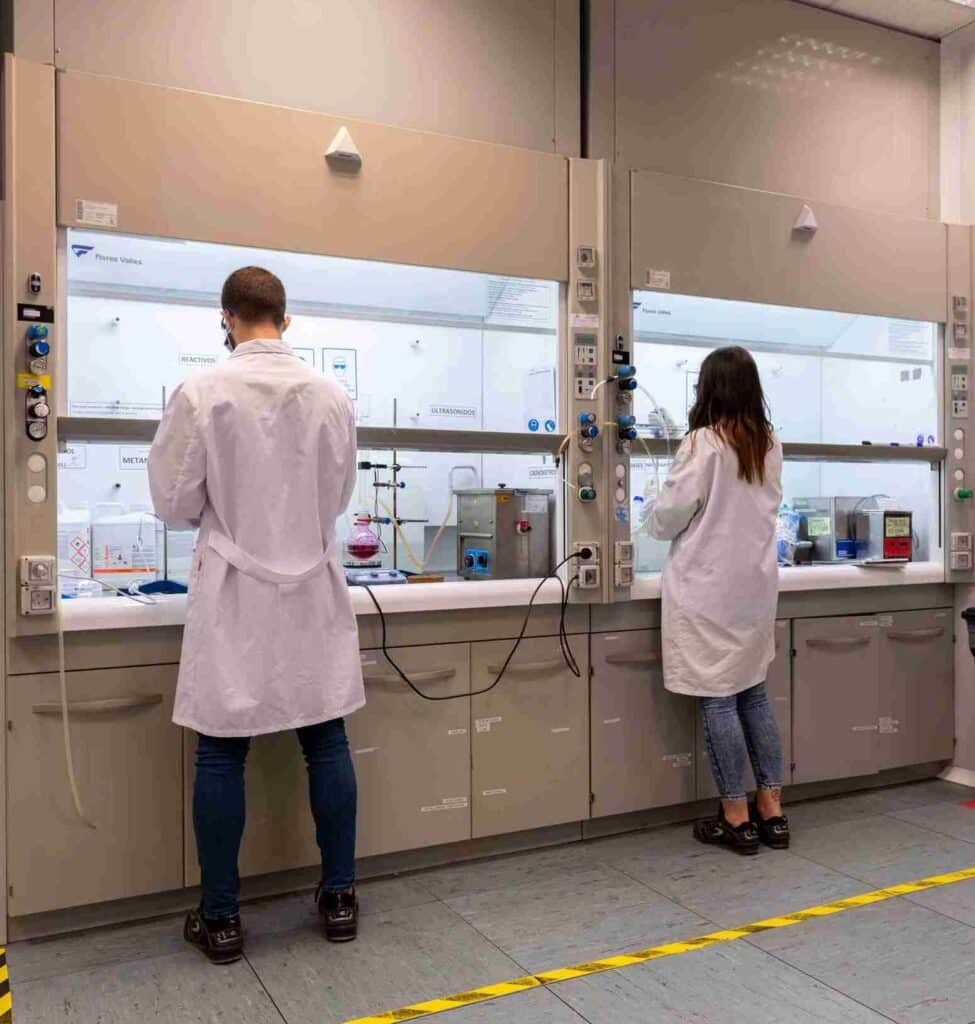
A controlled acid digestion was performed using hydrochloric acid and sulfuric acid. This step enabled the destruction of the organic matrix of the curry extract and brought the iron atoms into solution, releasing them from their original chemical environment. Digestion is a critical phase, as it directly affects the quality of the final analytical result.
The selection of these reagents and the digestion procedure was based on their effectiveness in decomposing organic matter and their compatibility with the subsequent instrumental technique. This minimized the risk of interferences and ensured that iron was fully available for quantification.
Iron quantification by UV-VIS spectrophotometry as the analytical technique
Once the iron had been released into solution, iron quantification by UV-VIS spectrophotometry was carried out. This technique is based on measuring the absorption of electromagnetic radiation at a specific wavelength, where the signal intensity is proportional to the concentration of the analyte in solution.
The method provided a clear analytical signal proportional to the iron content present in the plant extract. UV-VIS spectrophotometry offers an appropriate balance of sensitivity, speed, and reproducibility for this type of determination within food quality control.
UV-VIS spectrophotometry enables fast and reproducible quantification.
INFINITIA’s Forensic Engineering team applied internal controls and verification steps to ensure result consistency, confirming that the quantification met acceptable precision criteria for industrial decision-making.
Results focused on mineral content verification
The final outcome enabled objective mineral content verification based on validated analytical data. The iron concentration in the submitted samples was determined, providing a reliable quantitative reference.
With this information, the company was able to assess the consistency between the supplier’s specification and the actual value measured in the curry extract. This type of analysis provides a solid technical basis for supplier validation, specification adjustment, or revision of nutritional communication strategies if necessary.
The project is considered successful because it achieved accurate determination of iron concentration in a complex plant matrix, enabling informed decision-making prior to product launch. This case demonstrates INFINITIA’s capability to perform iron analysis in food and other tests aimed at quality control in demanding food matrices.