
The materials and instruments of the chemical laboratory are essential for the development of the industrial sector. Thanks to the laboratory equipment it is possible to carry out experiments, process controls and quality controls of the materials to ensure the quality of the products. In this article, we will see which are the fundamental instruments of a chemical laboratory and how, thanks to them, we can stand out from the competition.
What are chemical laboratory instruments for?
The laboratory instruments are used to carry out the analysis and synthesis of the materials. In this way, it is possible to test the materials, analyze their characteristics, analyze the root cause of a failure in the materials, develop new components and more resistant and efficient materials.
Since there are different procedures for analysis and synthesis, it is basic to know what type of procedure will be applied to use the appropriate laboratory instrument according to the function to be performed. Following this logic, instruments can be classified according to their function.
Classification of industrial chemical laboratory instruments
The different laboratory instruments can be classified according to the function they perform. The classic materials and instruments of the laboratory today share place with those that present the latest innovations in technological matters. The latter are indispensable in industrial laboratories when analysing different materials, establishing their properties and developing new products.
Chemical laboratory materials for sample preparation
The laboratory instruments used to prepare the samples of the material to be analyzed are the mortars, mills or dispensers. For example, the materials that make up the soil or the ceramics can be ground and thus prepared for further examination.
Chemical laboratory materials for the separation of compounds
These instruments are in charge of diluting the materials to separate the compounds and obtain a homogeneous material. To separate each of the materials there are different instruments ranging from sieves, distillers to centrifuges capable of separating emulsions and suspensions. To achieve the separation of the materials, the centrifuge works based on physical principles. During separation, the material with the highest density is pushed outwards by the centrifugal force, while, on the contrary, the material with the lowest density is moved inwards by works of the centripetal force.
Chemical laboratory instruments for optical observation
Instruments such as microscopes, refractometers and thermometers allow us the optical observation of the materials and their characteristics. In the different analyses, it is important to use high quality microscopes, which allow a thorough observation of the preparation. This applies to all laboratory instruments, but in the case of microscopes it is of utmost importance.
Chemical laboratory instruments for other tasks during the examination
This category includes all those laboratory instruments that perform support tasks in the analysis. Among them, magnetic stirrers, pumps and ovens stand out.
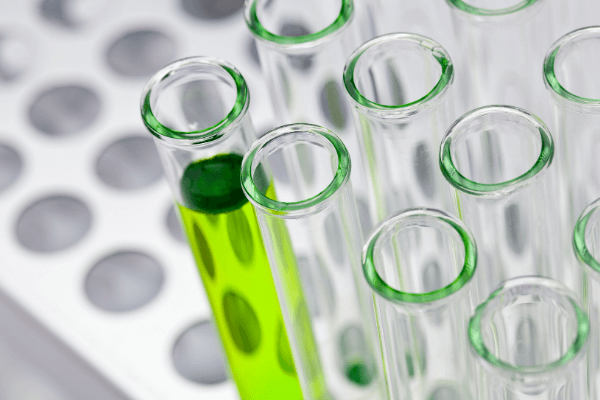
Of course, classic chemical laboratory instruments such as flasks, test tubes, crucibles, droppers, pipettes, balances, tweezers, spatulas, clamping rings, measuring instruments, etc. will never be missing. In addition to gloves, gowns and protective equipment to be worn by the laboratory technicians for carrying out the experimental tests.
Latest generation industrial chemical laboratory materials
Without a doubt, laboratory equipment is in constant evolution, and it is necessary for industries to carry out the analysis of their materials in laboratories that have the latest technology if they want to stand out from their competitors.
Elements such as chromatography equipment that are responsible for separating one or more types of relatively small molecules from a mixture of substances or that are also used to purify samples, are essential in research laboratories and in manufacturing processes in various types of industries.
For all the above reasons, we recommend that you contact professionals in the sector who have the most advanced laboratories, such as our laboratories for innovation of materials, which have all these and many more instruments to analyze, innovate and develop the best materials for your industry.