

The customer requested the development of a quantitative and automated method to evaluate biofilm growth on different surfaces.
Until now, the customer was using a qualitative method that was subjective and could be misleading when analyzing and classifying samples.
A quantitative method seeks to avoid these problems, since the results will become objective. In addition, if it is automated, it will allow a large number of samples to be analyzed efficiently in a short time.
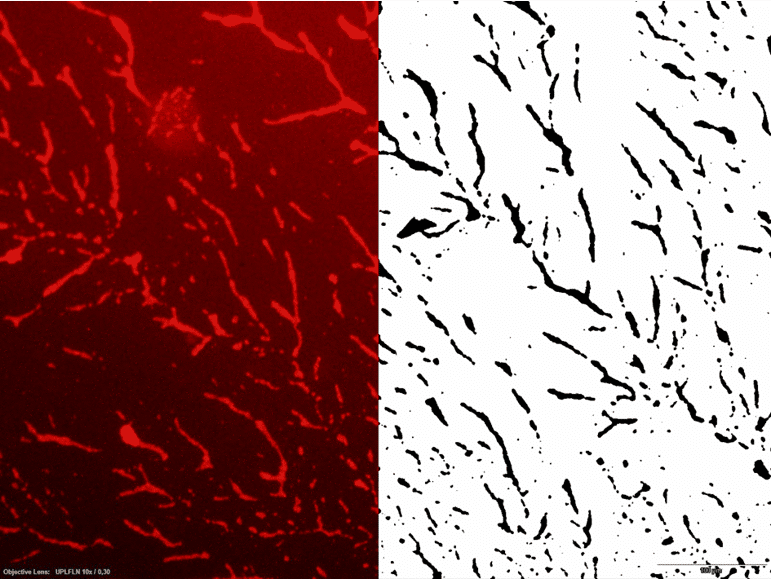
To address the problem, the Forensic Engineering team decided to use ImageJ image processing software to analyze biofilm photos obtained by epifluorescence microscopy.
Using this program, a specific macro was developed to obtain a percentage of area covered by biofilm, thus providing quantitative results.
In this way, the customer will have a new method of analysis that will allow him to obtain objective results of his samples, in a reduced time, and with the possibility of avoiding artifacts that falsify the results.
- Develop a biofilm analysis method that provides quantitative results.
- Use of ImageJ image processing software.
- Design of a macro to obtain the percentage of area covered by biofilm.